
SOSTAC vs RACE vs AIDA: The Ultimate Marketing Framework Comparison Guide (2026)
Every marketing leader eventually hits the same wall: too many frameworks, not enough clarity on which one actually drives the plan.
You’ve heard of SOSTAC. You’ve heard of RACE. You’ve built ad copy around AIDA without ever naming it. But when a board asks which methodology governs your 2026 strategy, “a bit of everything” is not an answer that survives scrutiny.
This is the tension we solve for clients every week at Taya Agency. SOSTAC vs RACE vs AIDA isn’t really a competition — it’s a stack. Each framework operates at a different altitude: SOSTAC plans the mission, RACE runs the digital lifecycle, and AIDA converts the individual moment. Confuse the layers, and you get plans with no execution, execution with no persuasion, or persuasion with no strategy behind it.
The 2026 marketing environment makes this worse. AI-generated search summaries compress the funnel. Buyers research anonymously across a dozen touchpoints before a single sales conversation happens. Attribution is fractured across channels, devices, and increasingly, AI assistants that answer questions before a brand ever gets a click. In that environment, structured thinking isn’t a nice-to-have — it’s the only way to know if your marketing is working at all.
This guide breaks down all three models in detail, compares them head-to-head, and shows you exactly how we at Taya Agency combine SOSTAC, RACE, and AIDA into a single operating system for growth. By the end, you’ll know not just what each framework does, but which one — or which combination — belongs in your 2026 marketing architecture.
Section 1: Understanding the Contenders (Deep-Dive Analysis)
The SOSTAC Framework: The Macro Strategic Planner
SOSTAC was created by marketing author PR Smith in the 1990s and later formalized in his book Marketing Communications. It has since been recognized by the Chartered Institute of Marketing as one of the most widely used business planning models in the world, and it remains the backbone of countless agency proposals, annual marketing plans, and board-level strategy documents.
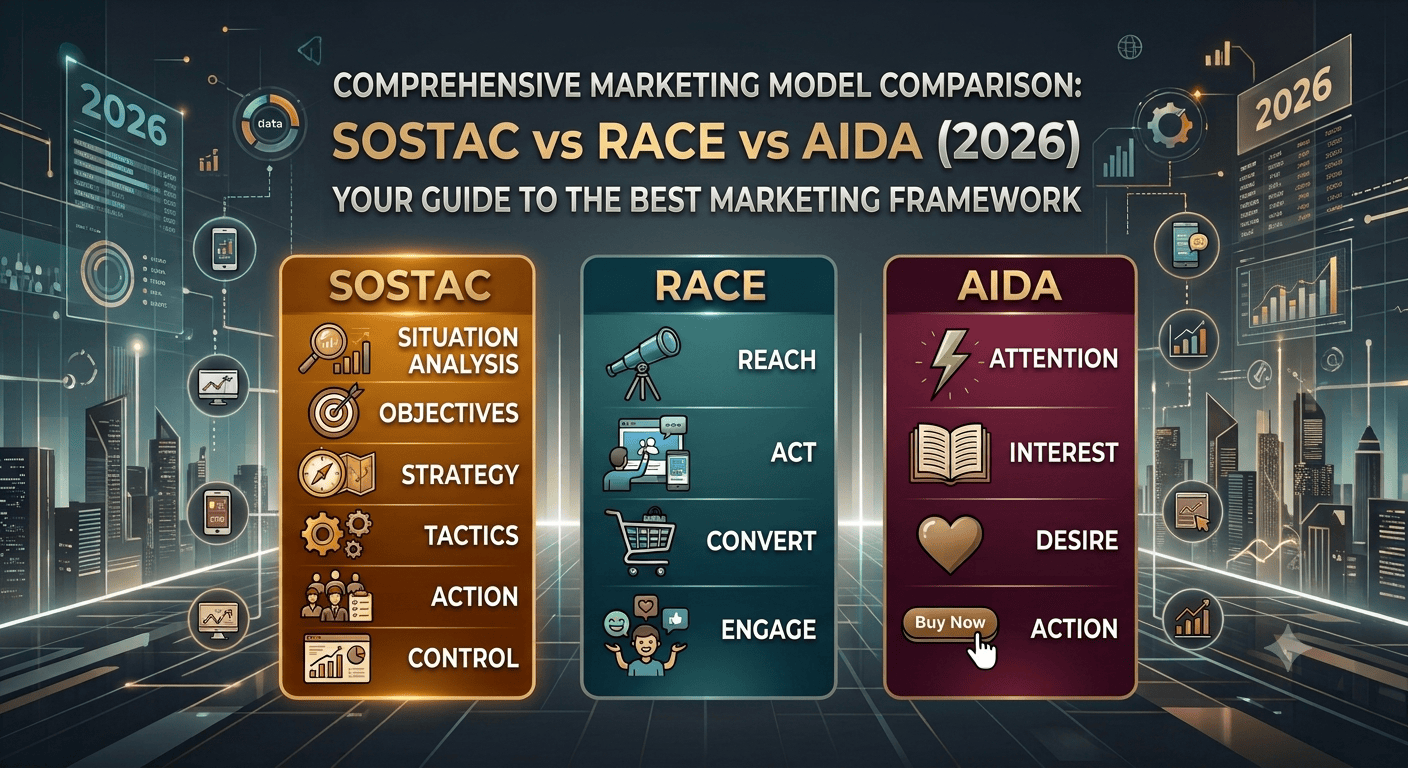
SOSTAC is a six-stage planning architecture:
- Situation — Where are we now? A full audit of market conditions, competitors, customer data, and internal capability (often built on a SWOT analysis).
- Objectives — Where do we want to be? SMART goals or OKRs that give the plan a measurable destination.
- Strategy — How do we get there, broadly? Positioning, targeting, and the overall shape of the journey.
- Tactics — What are the specific tools and channels? The “how” gets granular here — content, paid media, CRM, partnerships.
- Action — Who does what, and by when? Project plans, ownership, timelines, and resourcing.
- Control — How do we know it’s working? KPIs, dashboards, and a feedback loop that feeds the next Situation analysis.
Strengths: SOSTAC forces discipline. It is the rare framework that treats strategy and tactics as genuinely separate disciplines, which prevents the common trap of jumping straight to channel selection before objectives even exist. It is channel-agnostic, works for any industry, and scales from solo founders to multinational rebrands.
Limitations: SOSTAC is a planning skeleton, not an execution engine. It tells you that you need tactics and control, but it doesn’t prescribe how a digital customer journey actually behaves day to day. That’s a gap RACE was built to fill.
Ideal use cases: Annual marketing strategy, agency pitch documents, brand audits, and any moment where leadership needs a single document that justifies the “why” behind a budget.
For a full breakdown of every stage, see our Comprehensive Guide to the SOSTAC Framework, and for the original methodology straight from its creator, refer to PR Smith’s Official SOSTAC Methodology.
The RACE Model: The Digital Customer Lifecycle Engine
Where SOSTAC plans, RACE executes. Developed by Dr. Dave Chaffey, co-founder of Smart Insights, RACE was built specifically to structure digital marketing activity around the modern customer lifecycle. Chaffey created the framework after finding that a large share of businesses had no formal digital marketing plan at all, despite wanting one — RACE was the practical answer.
RACE breaks the digital journey into four stages, often preceded by an informal “Plan” stage (sometimes written as PRACE):
- Reach — Build visibility and traffic through SEO, paid media, social, and PR.
- Act — Encourage interaction: content engagement, email sign-ups, on-site behavior.
- Convert — Turn interest into revenue, whether that’s an online sale, a demo booking, or a signed contract.
- Engage — Retain, upsell, and turn customers into advocates through loyalty and long-term relationship-building.
[!NOTE] PRO-TIP RACE is iterative by design. Data from the Engage stage should always loop back to inform Reach — your best-performing customer profiles are your best future targeting inputs.
Strengths: RACE is customer-centric, channel-agnostic within digital, and measurable at every stage — each phase has its own KPIs (traffic, engagement rate, conversion rate, retention rate), which makes it far easier to diagnose where a funnel is leaking than a single blended conversion metric ever could.
Limitations: RACE assumes a reasonably mature digital marketing operation. Teams without analytics infrastructure or content capability will need to build that foundation before RACE delivers full value. It also doesn’t govern top-level corporate strategy — it needs a planning framework like SOSTAC above it.
Ideal use cases: Omnichannel digital campaigns, ecommerce growth, lifecycle marketing, and any organization trying to unify SEO, paid, email, and retention into one measurable system.
Explore the full model in RACE Marketing Model Explained, or go to the source at Smart Insights Digital Marketing Frameworks.
The AIDA Model: The Behavioral Persuasion Funnel
AIDA is the oldest of the three, tracing back to advertising theory from the late 19th century, and it remains the most widely taught model of consumer psychology in marketing education. Unlike SOSTAC and RACE, AIDA doesn’t plan a business or a channel — it maps the psychological sequence a person moves through before taking action.
- Attention — Interrupt the scroll. A headline, visual, or hook that earns the first three seconds.
- Interest — Give them a reason to keep reading: relevance, a problem well-articulated, a benefit worth exploring.
- Desire — Move from “this is relevant” to “I want this,” typically through proof, specificity, and emotional or commercial stakes.
- Action — A clear, low-friction next step: buy, book, subscribe, request a demo.
Strengths: AIDA is granular, fast to apply, and endlessly reusable at the level of a single ad, landing page, email subject line, or sales script. It requires no data infrastructure — just a clear understanding of the audience and the message.
Limitations: AIDA says nothing about channel selection, budget, or lifecycle retention. It operates entirely at the messaging layer, which means it’s easy to misuse as a whole-strategy replacement when it was only ever meant to govern the persuasion moment.
Ideal use cases: Ad copy, landing pages, email campaigns, sales scripts, and conversion rate optimization (CRO) work — anywhere a single piece of content needs to move someone from indifference to action.
Dive deeper in Mastering the AIDA Funnel.
Section 2: SOSTAC vs RACE vs AIDA (Head-to-Head Comparison)
| Feature / Dimension | SOSTAC | RACE | AIDA |
|---|---|---|---|
| Primary Focus | Overall marketing plan | Customer lifecycle / funnel | Copywriting & psychology |
| Scope | Macro-strategy | Digital channels & CX | Micro-conversion / messaging |
| Best For | Annual strategy & audits | Omnichannel campaigns | Content, ads & landing pages |
| Measurement Metric | KPIs vs. objectives | CAC, LTV, retention rate | CTR, CVR, micro-actions |
| Execution Complexity | High (requires deep audits) | Medium–high (requires data & tech) | Low–medium (focuses on messaging) |
| Time Horizon | Annual / quarterly | Ongoing / campaign-based | Single asset or campaign |
| Origin | PR Smith, 1990s | Dave Chaffey / Smart Insights, 2010 | Advertising theory, late 1800s |
Detailed Comparative Analysis
Scope & granularity. SOSTAC operates at 30,000 feet — it decides whether you should even be running a digital lead-gen campaign in the first place. RACE operates at 10,000 feet — it decides how that campaign moves someone from stranger to advocate. AIDA operates at ground level — it decides whether a specific headline earns a click. None of the three can substitute for the other two; they answer entirely different questions.
Flexibility & adaptability in 2026’s market. SOSTAC’s Control stage makes it naturally adaptive — its feedback loop is designed to feed learnings back into the next planning cycle, which matters when AI search behavior and buyer expectations are shifting quarter to quarter. RACE is inherently modular; you can strengthen Reach without touching Convert if that’s where the data points. AIDA is the most flexible at the tactical level, since a single AIDA-structured asset can be rewritten and A/B tested in hours, not months.
Measurement & analytics integration. This is where the three models diverge most sharply. SOSTAC measures success against strategic objectives (market share, brand equity, revenue targets). RACE measures success against lifecycle metrics — Customer Acquisition Cost (CAC), Lifetime Value (LTV), and retention rate. AIDA measures success against direct-response metrics — click-through rate (CTR) and conversion rate (CVR). A mature marketing organization needs all three measurement layers reporting simultaneously, because a healthy CTR on an ad (AIDA) means nothing if CAC is unsustainable (RACE), and a strong quarter of CAC means nothing if it isn’t moving the annual objective (SOSTAC).
[!NOTE] PRO-TIP If your reporting dashboard only shows one of these three measurement layers, you have a blind spot. Ask which layer is missing before you ask which channel to invest in next.
Execution complexity in practice. SOSTAC’s complexity comes from the depth of the audit it demands — a rushed Situation analysis produces a plan built on assumptions, not evidence, and that weakness cascades through every later stage. RACE’s complexity comes from the marketing technology and data integration it requires — you need working analytics, attribution tracking, and CRM visibility before Reach-to-Engage metrics mean anything. AIDA is the lowest-complexity of the three precisely because it deals in language, layout, and psychology rather than infrastructure, which is why it’s the framework most teams instinctively reach for first, even when they haven’t consciously named it.
Where organizations get the sequencing wrong. The most common failure mode we see at Taya Agency isn’t picking the wrong framework — it’s applying them out of order. Teams write AIDA-perfect ad copy before RACE has defined which lifecycle stage that ad is meant to serve, and they build RACE dashboards before SOSTAC has set an objective worth measuring against. The result is technically sound marketing that still can’t answer the one question every C-level stakeholder eventually asks: why did we do this, and how do we know it worked? Sequencing SOSTAC before RACE, and RACE before AIDA, is what keeps that question answerable at every level of the organization.
Section 3: The Hybrid Framework: How Taya Agency Combines All Three
Here’s the false dichotomy we push back on with every new client: the idea that you must pick one framework and discard the rest. SOSTAC, RACE, and AIDA were never competitors — they were built to solve entirely different problems, at different altitudes, for different audiences within the same organization. Treating them as mutually exclusive options is like asking whether a company needs a mission statement, a supply chain, or a sales script — the answer is obviously all three, operating together.
We at Taya Agency build what we call the Tri-Framework Stack, and it underpins every strategic engagement we run:
Step 1 — SOSTAC builds the umbrella. Before a single ad is written, we run the full SOSTAC cycle: audit the situation, define objectives in hard numbers, set the strategy (who we’re targeting and how we’re positioned), and establish the Control layer that will tell us if any of it worked. This is the corporate-level document that a CFO or board can sign off on.
Step 2 — RACE builds the machine. With SOSTAC’s Tactics stage as input, we map every digital touchpoint across Reach, Act, Convert, and Engage. This is where channel strategy, marketing technology stack, and lifecycle KPIs get defined. RACE turns SOSTAC’s abstract “digital tactics” line item into an operating system with owners, dashboards, and stage-by-stage targets.
Step 3 — AIDA builds the moment. Within every single RACE touchpoint — the paid ad driving Reach, the landing page driving Act, the checkout page driving Convert, the retention email driving Engage — we apply AIDA to the actual words and design. This is where strategy becomes a headline someone actually reads and acts on.
[!NOTE] PRO-TIP: The 2026 Agency Playbook When a client asks us to “just run some ads,” we always ask which RACE stage the ads are meant to serve first — and which SOSTAC objective that stage rolls up into. An AIDA-perfect ad pointed at the wrong RACE stage, in service of no clear SOSTAC objective, is still a wasted budget line, no matter how good the copy is.
This layered approach is also why AI-driven search and generative engines increasingly reward brands with this kind of structured thinking. Answer engines like Perplexity and Google’s AI features favor content and campaigns built on clearly defined, data-dense logic — exactly the kind of structured architecture the Tri-Framework Stack produces by design.
Section 4: Practical Case Scenario (B2B / High-Ticket Growth Blueprint)
To illustrate how this plays out in practice, consider a hypothetical mid-market B2B software company looking to scale qualified pipeline in 2026. This walkthrough is illustrative of how the Tri-Framework Stack is typically applied — not a specific client result.
SOSTAC layer: Situation analysis reveals a strong product but an inconsistent inbound presence and no formal marketing plan. Objectives are set: grow qualified pipeline meaningfully within two quarters while improving marketing efficiency. Strategy: reposition around a specific, underserved buyer segment rather than competing broadly. Control: weekly pipeline dashboards tied directly back to the stated objectives.
RACE layer: Reach is rebuilt around targeted SEO content and LinkedIn thought leadership aimed at the newly defined segment. Act is engineered through gated resources and an improved on-site experience. Convert is restructured around a shorter, more qualified demo-request path. Engage introduces a structured onboarding and account-expansion sequence for closed customers.
AIDA layer: Every asset inside that RACE structure — the LinkedIn hook, the resource landing page, the demo-request page, the onboarding email sequence — is rewritten against Attention, Interest, Desire, and Action, rather than left as generic corporate messaging.
Illustrative outcome: In engagements structured this way, we typically model toward outcomes in the range of a 40% increase in qualified pipeline and a 25% reduction in CAC over two quarters — figures we present here as a modeled target range for planning purposes, not a guaranteed or historical result. The actual gains in any engagement depend on starting maturity, budget, and market conditions, which is precisely why the SOSTAC Control stage exists — to test the plan against reality and adjust.
Section 5: Which Framework Should You Choose? (Decision Matrix)
Use this as a quick decision tree based on your organization’s size, goals, timeline, and internal capability:
- You have no formal marketing plan at all → Start with SOSTAC. You need the Situation-to-Control skeleton before anything else makes sense.
- You have a strategy but a fragmented or underperforming digital funnel → Layer in RACE. This is the right move once objectives exist but execution across channels feels disconnected.
- Your strategy and funnel are solid, but conversion rates on specific assets are weak → Apply AIDA at the asset level — ads, landing pages, email sequences.
- You’re a small team with limited resources → Start light: a lean SOSTAC one-pager, a simplified two-stage RACE focus (Reach + Convert), and AIDA-driven copy on your highest-traffic pages.
- You’re an enterprise or scaling B2B organization → Run the full Tri-Framework Stack. At this scale, skipping any one layer creates measurable gaps — a strategy without lifecycle execution, or a funnel without persuasive messaging, both leak revenue.
- Your campaign timeline is under 90 days → Lead with AIDA and a lightweight RACE structure; a full annual SOSTAC cycle isn’t the right tool for a short sprint, though a mini-Situation and Objectives check is still worth doing.
- Your campaign timeline is 6–12+ months → SOSTAC should govern from day one, with RACE and AIDA nested inside it.
Conclusion & Strategic Recommendation
The debate over SOSTAC vs RACE vs AIDA dissolves the moment you stop treating them as competitors. SOSTAC plans the overall marketing mission. RACE executes that mission across the digital customer lifecycle. AIDA converts each individual moment inside that lifecycle into action. Used together, they form a complete marketing architecture — from boardroom strategy down to the exact words on a landing page.
In a 2026 landscape shaped by AI-driven search, fractured attribution, and increasingly self-directed buyer journeys, this kind of layered structure isn’t academic — it’s the difference between marketing that compounds and marketing that churns budget without a clear line back to strategy.
We at Taya Agency built our entire strategic methodology around this Tri-Framework Stack because we’ve seen what happens when any one layer is missing: strategies with no execution, execution with no persuasion, or persuasion with no strategic direction behind it.
If you’re not sure which layer is missing in your own marketing, that’s exactly the audit we run. Explore Taya Agency’s Strategic Marketing Services and let’s find out where your framework has a gap — and fix it.
Frequently Asked Questions
What is the main difference between SOSTAC, RACE, and AIDA?
SOSTAC is a strategic planning framework covering an entire marketing plan, from situation analysis to control. RACE is a digital customer lifecycle model covering Reach, Act, Convert, and Engage. AIDA is a persuasion model for individual messages, guiding a reader from Attention to Action.
Can you combine SOSTAC and RACE in a single marketing strategy?
Yes, and it’s a widely recommended pairing. SOSTAC provides the strategic umbrella — objectives, strategy, and control — while RACE operationalizes the digital tactics inside that plan across the full customer lifecycle, from initial reach through long-term engagement.
Which framework is best for modern B2B lead generation in 2026?
No single framework is sufficient alone. B2B lead generation in 2026 benefits most from a layered approach: SOSTAC for strategic direction and measurable objectives, RACE for lifecycle execution across channels, and AIDA for persuasive messaging at each conversion point.
Is AIDA still relevant for modern digital marketing?
Yes. While over a century old, AIDA’s psychological sequence still underlies effective ad copy, landing pages, and email marketing. It doesn’t replace strategic planning frameworks, but it remains one of the most reliable tools for structuring persuasive, action-driving content.
How does Taya Agency choose the right framework for clients?
We assess three things: whether a strategic plan exists (SOSTAC gap), whether the digital lifecycle is structured and measurable (RACE gap), and whether messaging converts effectively at each touchpoint (AIDA gap). Most clients need work across all three layers, applied as a single integrated stack.