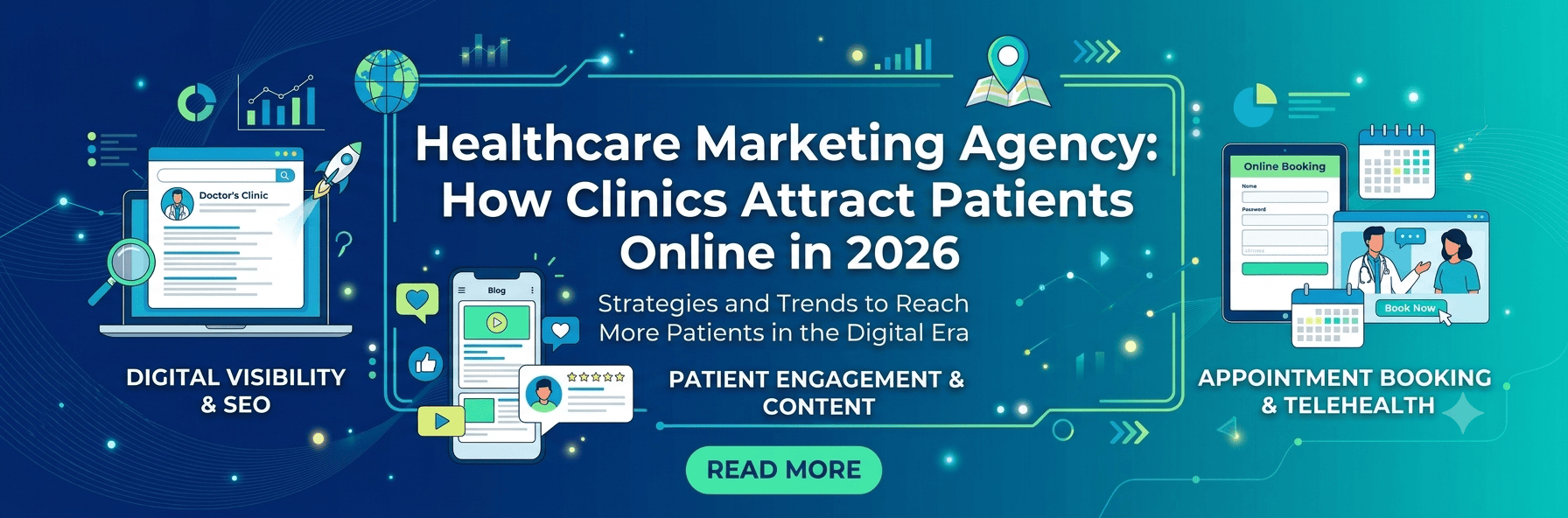
Healthcare Marketing Agency: How Clinics Attract Patients Online in 2026
Every single day, patients in your area search for exactly the care your clinic provides — and book an appointment with a competitor instead, simply because that competitor showed up first, looked more trustworthy, or answered their questions before you did.
That’s not a staffing problem or a quality-of-care problem. It’s a visibility problem, and it’s the single biggest reason growing clinics fall behind smaller competitors with weaker medicine but stronger digital presence.
The fix is a proper healthcare marketing agency — not a generalist shop running the same playbook for restaurants and law firms, but a partner that understands patient trust, HIPAA-sensitive messaging, and the specific way people search before they book a medical appointment. TAYA Agency works exclusively with clinics, medical centers, and physicians as a specialized healthcare growth agency, and offers a Book a free clinic marketing audit with TAYA Agency session for practices that want a clear picture of where they’re losing patients online.
Search behavior data backs up how urgent this is. Research on Google’s role in the patient journey shows that a large majority of consumers now begin their care decisions with an online search, and read provider reviews before ever calling a front desk. This guide breaks down exactly what a modern healthcare marketing agency should deliver in 2026, and how to evaluate one before you sign a contract.
Why Traditional Marketing Fails Clinics and Medical Centers
A billboard on the highway or a table at a community health fair used to be enough. In 2026, those channels still have a place — but they can no longer carry the weight of new-patient acquisition on their own.
Medical Trust Is Not the Same as Product Trust
Buying a product is a low-stakes decision you can reverse with a return policy. Choosing a doctor, a dermatology clinic, or a physical therapy center is a decision people make carefully, often while anxious or in pain.
That changes what marketing has to accomplish before a patient ever calls:
- It has to demonstrate real clinical credibility, not just design polish.
- It has to be transparent about pricing, availability, and what a visit involves.
- It has to respect strict ethical and legal boundaries around patient information.
Reviews and Transparency Now Decide the Visit
Patients no longer choose a provider from a phone book or a single referral. They compare Google ratings, read recent reviews, and check whether a practice responds to feedback at all.
Pro-Tip: An incomplete or outdated Google Business Profile is often the single biggest silent leak in a clinic’s new-patient pipeline — patients bounce to a competitor’s listing before they even reach your website.
Deeper detail on how this digital-first behavior shapes provider selection is available through Google’s Patient Search Insights, which outlines how consistently patients now research online before booking care.
5 Essential Pillars of a Healthcare Marketing Agency for Your Clinic
If you’re comparing agencies offering digital marketing for medical practices, these five pillars separate the ones who understand healthcare from the ones repurposing a generic template.
1. Local SEO and Google Business Optimization
Most patients search for care near them — “dentist near me,” “pediatrician [city],” “urgent care open now.” Winning that local map pack is often worth more than any paid ad campaign.
- A fully optimized, verified Google Business Profile with accurate hours, services, and photos
- Location-specific landing pages for every service and every clinic branch
- Consistent name, address, and phone (NAP) data across directories
Pro-Tip: Google rewards Business Profiles that get fresh reviews consistently, not just a batch of five-star reviews once a year. Build a system, not a one-time push.
2. Patient Conversion Funnels
Traffic without bookings is worthless. A real patient conversion funnel guides a website visitor from “just researching” to “appointment confirmed” with minimal friction — clear calls-to-action, simple online booking, and fast response times to inquiries.
This is precisely what TAYA’s automated patient acquisition systems are built to handle: turning search traffic and ad clicks into confirmed appointments instead of abandoned contact forms.
3. Reputation and Review Management System
Reviews are no longer optional social proof — they’re one of the strongest ranking and conversion factors a clinic has. A proper system automatically requests reviews after each visit, flags negative feedback for fast resolution, and showcases strong reviews across the website and profile.
- Automated post-visit review requests via SMS or email
- Real-time alerts for new reviews, especially negative ones
- Consistent, professional public responses to every review
4. Educational Content Engine (Built Around Compliance)
Educational content — symptom guides, treatment explainers, FAQs about procedures — builds authority and answers the questions patients are already typing into Google. But healthcare content carries legal weight that other industries don’t.
Every piece of content, every ad, and every patient-facing message has to respect HIPAA marketing compliance rules, particularly around testimonials, targeted advertising, and any use of patient information.
Pro-Tip: Never use real patient photos, names, or identifiable case details in marketing without documented, HIPAA-compliant authorization — even a well-meaning “success story” post can create serious liability.
5. Patient Retention and Nurturing
Acquiring a new patient costs significantly more than keeping an existing one engaged. A retention system re-engages patients for annual check-ups, follow-up visits, and preventive screenings automatically, rather than relying on the patient to remember on their own.
How to Choose the Right Healthcare Marketing Agency (Green Flags vs. Red Flags)
Ask these questions before signing any contract, and treat vague or evasive answers as a warning sign.
- “Have you worked with clinics in my specialty before?” — Dermatology, dental, and physical therapy marketing all behave differently.
- “How do you keep our marketing content and ads HIPAA-compliant?” — If they can’t explain this clearly, walk away.
- “What is our current Patient Acquisition Cost, and what’s the target?” — Vague reporting almost always hides underperformance.
- “How do you handle negative reviews?” — A strong process, not panic, should be the answer.
- “Can I see a real, redacted dashboard from a current client?” — Reputable agencies can show this without hesitation.
- “What happens to our website, content, and patient list if we leave?” — You should always retain ownership of your own assets.
The same core evaluation logic — checking for industry-specific expertise over generic promises — applies whether you’re vetting a healthcare partner or comparing notes with adjacent guides like digital marketing systems for coaches or marketing strategies for consultants.
Generic Agency vs. Specialized Healthcare Marketing Agency
| Criteria | Generic Marketing Agency | Specialized Healthcare Agency (like TAYA) |
|---|---|---|
| Compliance knowledge | Limited or none | Built around HIPAA marketing compliance |
| Local SEO focus | Basic, unoptimized listings | Deep local map-pack and multi-location strategy |
| Content strategy | Generic blog posts | Symptom- and treatment-specific patient education |
| Review management | Manual or nonexistent | Automated, systematic, real-time |
| Funnel design | Simple contact forms | Full patient booking and conversion funnel |
| Reporting | Vanity traffic metrics | Patient Acquisition Cost and booked-visit attribution |
McKinsey’s ongoing research on digital transformation in healthcare reinforces why this specialization matters: providers that invest deliberately in digital patient engagement consistently outperform those treating it as an afterthought. See more in McKinsey Healthcare Insights.
Case Study: Cutting Patient Acquisition Cost by 40% in 90 Days
Consider a composite, illustrative scenario reflecting the pattern TAYA sees repeatedly with multi-specialty medical centers — a mid-sized practice offering primary care, dermatology, and physical therapy under one roof.
Starting point: An outdated website, an unclaimed and inconsistent Google Business Profile across two locations, no structured review request process, and a Patient Acquisition Cost that had crept upward for two straight quarters.
What changed over a 90-day rollout:
- Weeks 1–3: Rebuilt and verified Google Business Profiles for both locations, corrected NAP inconsistencies across directories, and restructured the website into service- and location-specific pages.
- Weeks 4–8: Launched an automated post-visit review request system and rebuilt the intake funnel with online booking and faster response times to inquiries.
- Weeks 9–12: Layered in HIPAA-compliant educational content targeting the clinic’s highest-margin services, then scaled ad spend behind the pages converting best.
Illustrative result pattern: monthly booked appointments roughly doubled, Google review volume grew substantially with a stronger average rating, and Patient Acquisition Cost dropped by approximately 40% as local visibility and conversion improved together — consistent with the pillars described throughout this guide.
Verified, documented outcomes from real clinic engagements are available in TAYA’s clinic growth case studies.
Conclusion: Make Your Clinic the Obvious First Choice
Patients are searching for care right now, in your city, for the exact services your clinic offers. The only question is whether they find you first, or find a competitor with a stronger digital presence and less clinical experience.
A specialized healthcare marketing agency closes that gap — combining local SEO, a real patient conversion funnel, automated reputation management, compliant educational content, and retention systems into one coordinated engine, rather than a scattered set of one-off tactics.
If your clinic is ready to stop losing patients to competitors with weaker medicine but stronger marketing, Book a free clinic marketing audit with TAYA Agency and get a clear, specific breakdown of where your current strategy is leaking new patients.

Frequently Asked Questions
Why should a medical clinic hire a specialized healthcare marketing agency instead of a general agency?
General agencies rarely understand HIPAA compliance, patient trust dynamics, or how local medical search behaves. A specialized healthcare marketing agency builds compliant content, manages reviews properly, and structures funnels around how patients actually choose providers, reducing legal risk and improving conversion.
How long does it take to see more patient appointments from healthcare SEO?
Local SEO improvements, like Google Business Profile optimization, can show early movement within 30 to 60 days. Stronger organic rankings and a steady increase in booked appointments typically build over 90 days as content, reviews, and technical fixes compound together.
How do you handle patient data privacy (HIPAA) in digital marketing campaigns?
Compliant campaigns avoid using identifiable patient information without documented authorization, use HIPAA-compliant forms and tracking tools, and train staff on what testimonials or case studies can legally include. Any agency handling clinic marketing should be able to explain these safeguards clearly and specifically.
What is a good Patient Acquisition Cost (PAC) for private clinics in 2026?
A “good” PAC varies widely by specialty and average patient lifetime value, but most primary care and multi-specialty clinics aim to keep acquisition cost well below the revenue generated by a single new patient’s first visit and follow-ups. The right benchmark depends on your specific service mix and margins.
How does TAYA Agency help clinics convert online visitors into actual clinic visits?
TAYA builds full patient conversion funnels that combine local SEO, HIPAA-compliant content, streamlined online booking, and automated reputation management, so website visitors and searchers are guided smoothly from initial interest to a confirmed, attended appointment.