
Email Marketing in 2026 : The Complete Strategy Guide for Predictable Pipeline Growth
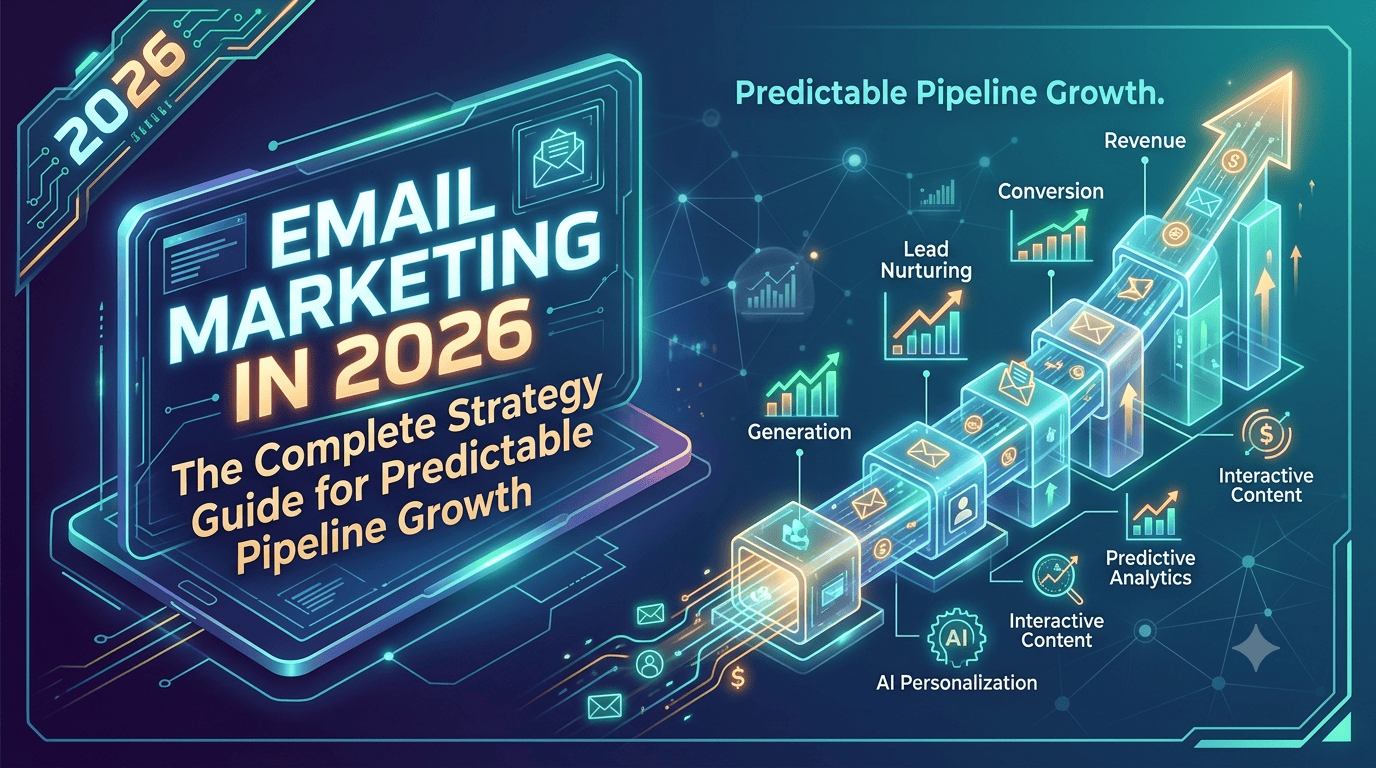
Email Marketing in 2026 : The Complete Strategy Guide for Predictable Pipeline Growth
While paid social and AI search are reshaping how B2B buyers discover vendors, the inbox remains where most real buying conversations actually happen. Email marketing continues to be one of the highest-ROI channels available to growth teams, but the tactics that worked five years ago — generic newsletters, batch-and-blast promotions, one-size-fits-all drip sequences — no longer move the needle. This guide breaks down what actually works for email marketing in 2026, from strategy and segmentation to deliverability and the KPIs that matter to a revenue leader, not just a marketing dashboard.
Why Email Marketing Still Outperforms in 2026
Despite predictions that email would be replaced by chat, social DMs, or AI assistants, the data tells a different story. A majority of B2B marketers report that email marketing generates more revenue than any other channel they run, and industry benchmarks put average email ROI between $36 and $42 for every dollar spent, according to HubSpot’s latest marketing statistics report. B2B audiences also engage differently than consumers: business buyers research longer, involve more stakeholders, and rely on email as the connective tissue across a multi-touch, multi-month sales cycle. That makes email marketing less about a single great campaign and more about a system that nurtures the same buyer over weeks or months.
Start With Strategy, Not a Send Button
The most common reason email marketing underperforms isn’t bad copywriting — it’s the absence of a strategy behind the calendar. Before building a single sequence, clarify who you’re emailing (by role, industry, and deal stage), what outcome each email is meant to drive, and how email fits alongside SEO, paid, and outbound in your broader funnel. Teams that document this upfront consistently outperform teams that improvise send-by-send. If your email marketing program doesn’t sit inside a documented marketing strategy, that’s the gap to close first — everything downstream, from segmentation to subject lines, depends on it.

Segment by Buying Stage, Not Just Industry or Title
Most B2B teams segment lists by firmographic data alone — industry, company size, job title — and stop there. That’s a reasonable starting point, but it misses the variable that actually predicts whether someone opens and acts on an email: where they are in the buying journey. A cold prospect who downloaded a single guide needs educational, low-pressure content. A lead who attended a demo and visited your pricing page needs a very different message. Layering buying-stage data on top of firmographics is what turns a generic newsletter into email marketing that converts, because every recipient gets content that matches their actual intent rather than a one-size-fits-all blast.
Personalization and AI: From Mail Merge to Real Relevance
Personalization in email marketing has moved well past inserting a first name into a subject line. Personalized subject lines alone can lift open rates by 20–26%, and the majority of B2B marketers now report using some form of personalization in their campaigns. The shift in 2026 is toward AI-assisted personalization at scale: dynamic content blocks that change based on industry or role, send-time optimization, and subject-line testing informed by historical engagement data. None of this works, though, without a clear message framework. Classic copywriting models like AIDA still hold up well inside email marketing, and it’s worth revisiting how the AIDA model structures attention-to-action sequences before you start writing at scale.
Automate the Nurture, Not the Relationship
Marketing automation is what makes consistent email marketing possible without a team manually sending every message. Behavior-triggered nurture sequences — welcome series, post-demo follow-ups, re-engagement flows for cold leads — keep prospects warm between sales touches and free your team to focus on the conversations that need a human. The mistake to avoid is treating automation as a way to disappear behind the system entirely; the best-performing flows still sound like a person wrote them, with clear, value-first messaging at every step. If your current setup is closer to a single static newsletter than a connected nurture system, this is usually where a dedicated email automation and lead-nurturing setup pays for itself fastest.
Write Copy That Earns the Click
B2B inboxes are crowded with vendor pitches, which means subject lines and opening lines carry more weight than ever. Lead with a specific, relevant problem or insight rather than a company name or generic offer — decision-makers consistently ignore emails that read as irrelevant or templated. Keep the body focused on one idea and one call to action; email marketing performs best when each message asks the reader to do exactly one thing, whether that’s booking a call, reading a resource, or replying with a quick answer. Reports also show B2B emails achieve a notably higher click-to-open ratio than B2C emails, which suggests B2B audiences reward relevance and punish noise more sharply than consumer audiences do.
Deliverability in 2026: Meeting Gmail’s New Sender Rules
None of the above matters if your emails never reach the inbox. Since 2024, Google and Yahoo have enforced stricter requirements for bulk senders, and enforcement tightened further through 2025 and into 2026. Any email marketing program sending meaningful volume should have SPF, DKIM, and DMARC authentication correctly configured, one-click unsubscribe enabled via List-Unsubscribe headers, and spam complaint rates kept well below Google’s 0.3% threshold. Google’s own email sender guidelines are the most reliable source for current requirements, since thresholds and enforcement timelines have shifted more than once. Skipping this technical layer is the fastest way to make an otherwise strong email marketing strategy invisible.
Tie Email to Your Content and SEO Engine
The best email marketing programs don’t operate in isolation — they’re fed by the same content and SEO work that drives organic traffic. Blog posts, case studies, and gated guides give you something genuinely useful to email about, instead of recycling promotional asks. This also compounds over time: content built for B2B SEO that attracts qualified leads becomes nurture content for email, and email engagement data tells you which topics are worth doubling down on in your content and SEO strategy. Treating these as one connected system, rather than two separate channels, is one of the clearest ways to make email marketing more efficient without increasing send volume.
The KPIs That Actually Matter
Open rate and click-through rate are useful diagnostics, but they aren’t business outcomes. For email marketing, the metrics worth reporting to leadership are pipeline influenced, meetings booked, and revenue sourced or accelerated by email touches. Track these alongside list health metrics — bounce rate, spam complaint rate, and unsubscribe rate — since a technically healthy list is what makes the revenue metrics trustworthy in the first place. A program that reports only vanity metrics tends to lose budget; a program that ties email directly to pipeline tends to grow it.
Common Mistakes That Quietly Kill B2B Email Performance
Three patterns show up repeatedly in underperforming email marketing programs: buying or scraping contact lists instead of growing them organically, sending the same message to every segment regardless of buying stage, and never auditing list hygiene until deliverability has already collapsed. Each of these is preventable with the strategy, segmentation, and technical setup covered above — they’re rarely a copywriting problem at the root.
Frequently Asked Questions
How often should B2B companies send marketing emails? There’s no universal number, but consistency matters more than frequency. Most B2B programs perform well sending one to two value-focused emails per week to active segments, with lighter cadences for cold or dormant contacts.
What’s a good email open rate for B2B companies? Healthy B2B open rates typically range from 20–30%, though this varies by industry and list quality. Click-through rate and pipeline impact are more reliable indicators of success than open rate alone.
Is cold email still effective for B2B in 2026? Yes, when it’s targeted, personalized, and compliant with current sender requirements. Generic, high-volume cold email performs poorly and increasingly risks deliverability problems under Google and Microsoft’s current rules.
Should B2B companies use AI to write email content? AI can speed up drafting and subject-line testing, but it works best as a starting point that’s refined with real audience insight and a clear strategic brief — not as a fully automated replacement for one.
Building an Email Marketing System That Compounds
Email marketing rewards teams that treat it as an ongoing system rather than a campaign calendar: a clear strategy, segmented and well-maintained lists, automation that supports real nurturing, and technical deliverability that keeps everything landing in the inbox. If your current program is missing one or more of these pieces, that’s usually the highest-leverage place to start. TAYA Agency works with expert-led and B2B brands to build exactly this kind of system — from marketing strategy through automation and content. Book a strategy call to see where your email program has the most room to grow.