
SOSTAC for Consultants: The Complete Guide to Building a Strategic Marketing Plan
Most consultants don’t fail at marketing because they lack ideas. They fail because they lack a plan. They post content randomly, test an ad here, run a campaign there — then wonder why none of it turns into real clients.
That’s exactly the gap SOSTAC for Consultants closes. It’s the application of the well-known SOSTAC strategic framework, adapted specifically to how consulting businesses actually work: on trust and expertise, not on selling a packaged product.
In this guide, we’ll break down the SOSTAC model step by step and show how any consultant or boutique firm can use it to build a clear, measurable marketing plan that actually leads to high-ticket clients.
What Is the SOSTAC Model?
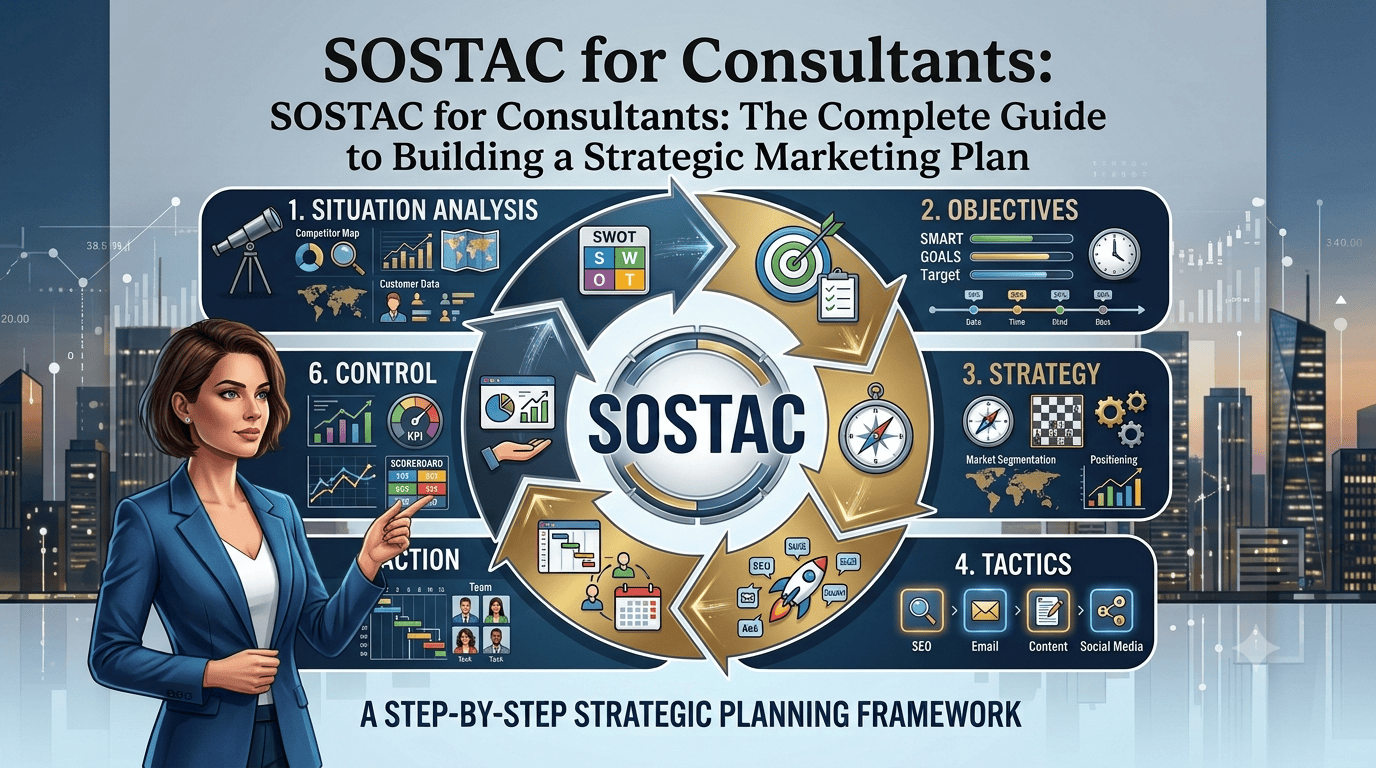
SOSTAC is a strategic planning framework developed by British marketer PR Smith in the 1990s. It has since become one of the most widely used marketing planning models in the world. The name stands for six sequential stages:
- Situation — Where are we now?
- Objectives — Where do we want to go?
- Strategy — How will we get there?
- Tactics — What are the specific tools and execution details?
- Action — Who does what, and when?
- Control — How do we measure success and adjust course?
SOSTAC® is a registered trademark of PR Smith, and it’s still taught and applied today by organizations and institutions like CIM (the Chartered Institute of Marketing) as a foundation for building any serious marketing plan.
Pro Tip: The difference between a marketing plan that works and one that doesn’t rarely comes down to the tools used. It comes down to whether there’s a clear framework tying every marketing activity back to a specific, measurable goal — which is exactly what SOSTAC provides.

Why Consultants Specifically Need SOSTAC
Consulting is fundamentally different from selling a standard product or service. You’re not selling “a thing.” You’re selling your professional judgment, your experience, and your ability to solve a complex problem for your client.
That means the buying cycle is longer, trust has to be built before the sale rather than after it, and any marketing that isn’t grounded in a clear strategy will burn time and budget without producing real results.
This is why applying SOSTAC for Consultants isn’t a nice-to-have — it’s a necessity. It forces you to answer the fundamental questions — Who is my ideal client? What’s my competitive position? What are the real indicators of success? — before you spend a single dollar on marketing activity.
If you’re looking for a specialized partner to build this strategy for you from the ground up, we cover this in depth in our full guide to marketing agency for consultants, which explains exactly how a specialized marketing agency works with consultants using this same framework as its foundation.
The SOSTAC Framework for Consultants, Stage by Stage
1. Situation Analysis: Where Do You Stand Today?
Before any marketing move, you need an honest audit of where you actually stand:
- What are your current marketing channels, and how is each one performing?
- Who are your direct competitors, and how are they positioned?
- What are your real strengths as an expert in your field, and where are the gaps in your personal brand?
This stage of SOSTAC for Consultants typically includes a full audit of your LinkedIn profile, your published content, and the channels your current clients actually come from.
2. Objectives: What Exactly Do You Want to Achieve?
Vague goals like “I want more clients” don’t hold up as a strategy. Objectives need to be specific and measurable:
- Number of qualified discovery calls per month
- Target average deal size
- Percentage reduction in referral-only dependency
3. Strategy: How Will You Get There?
This is where you define the “big idea.” Will you focus primarily on building your personal brand on LinkedIn? Will personal branding for experts be the central pillar? Or will long-form educational content be what builds your authority in a specific niche?
4. Tactics: The Execution Details
These are the actual tools: a weekly content calendar, direct LinkedIn outreach messages, a lead magnet landing page, a follow-up email sequence. Every tactic should serve the strategy defined in the previous stage — not get picked at random because it’s trending.
5. Action: Who Executes, and When?
A plan without clear ownership stays a document nobody follows. Who writes the content? Who follows up on messages? What’s the actual timeline for each activity?
6. Control: How Do You Measure Success?
The final — and arguably most important — stage is the regular review: a weekly or monthly check of actual performance against the objectives set in stage two, with course corrections made as needed.
Pro Tip: The most common mistake consultants make is skipping the Situation and Objectives stages entirely and jumping straight to Tactics. The result: a lot of marketing activity, but no clear direction and nothing measurable to show for it.
Random Marketing vs. Applying SOSTAC for Consultants
| Factor | Random Marketing | Applying SOSTAC for Consultants |
|---|---|---|
| Starting Point | A random idea or channel | A realistic audit of the current situation |
| Objectives | Vague, unmeasured | Specific and measurable |
| Channel Selection | Trial and error | Driven by clear strategy |
| Measurement | Irregular or absent | Consistent, scheduled review (Control) |
| Long-Term Outcome | Repeated effort with no compounding | A scalable, repeatable marketing system |
How to Apply SOSTAC in Your Consulting Business
- Block off half a day to honestly analyze your current situation — don’t skip this step, no matter how obvious it feels.
- Write down only 2–3 measurable objectives, not a long wish list.
- Define one clear strategy before thinking about any specific tactic or channel.
- Build a simple execution plan that assigns an owner and a date to each activity.
- Set a fixed monthly date to review actual numbers against your stated objectives.
This is exactly the approach Taya Agency applies on every consulting engagement — every project starts with a full SOSTAC session before any marketing activity is executed.
Mini Case Study: From a Scattered Plan to a Clear System
The following scenario is illustrative, based on recurring patterns seen in boutique consulting engagements. It should be replaced with real client data when available.
A management consultant was relying on irregular LinkedIn posts and paid ads with no clear strategy behind them. After fully applying SOSTAC for Consultants:
- One specific niche was defined instead of targeting a broad audience
- A content calendar was built and tied directly to the objective of “increasing qualified calls per month”
- Performance was reviewed monthly, and content type was adjusted based on actual data
The result after three months: a noticeable increase in qualified discovery calls, and a meaningful drop in total dependency on referrals as the sole client source.
Conclusion
Marketing without a clear strategy is just activity, not a plan. Applying SOSTAC for Consultants gives you a simple, repeatable framework that ties every marketing activity back to a specific objective — starting with understanding where you actually stand and ending with measuring real results.
If you want to build a complete SOSTAC plan for your consulting business instead of piecing it together on your own, the Taya Agency team is ready to help. Book a free consultation with Taya Agency today to build your strategic plan, or check out our full guide to marketing agency for consultants to see how this strategy fits into the rest of a complete marketing engagement.
Frequently Asked Questions
What is the SOSTAC model? SOSTAC is a strategic planning framework developed by PR Smith, made up of six stages: Situation, Objectives, Strategy, Tactics, Action, and Control. It’s used to build structured, measurable marketing and business plans.
Why is SOSTAC especially well-suited for consultants? Because consulting relies on trust and personal expertise rather than a tangible product, clear strategic planning is essential for identifying the right audience and building a cohesive marketing message that attracts higher-value clients.
How long does it take to build a full SOSTAC plan? Building an initial SOSTAC plan usually takes one to two weeks, while real execution results — like an increase in qualified calls — typically start showing within 60 to 90 days of consistent implementation.
Is SOSTAC only for independent consultants, or does it work for consulting firms too? The model is flexible enough for both. An independent consultant usually needs one clear niche and channel, while larger consulting firms need to coordinate multiple partners’ personal brands under one unified strategy.
What’s the difference between SOSTAC and the RACE model? SOSTAC provides the overall strategic foundation for the plan, while the RACE model focuses on organizing the customer journey across reach, act, convert, and engage stages. The two are often used together to cover both strategy and detailed execution.
Reference sources: Smart Insights, SOSTAC Marketing Planning Model; CIM, SOSTAC Plans in the AI Age; Dave Chaffey, SOSTAC Marketing Plan Model Definition. SOSTAC® is a registered trademark of PR Smith.