Marketing Automation for Consultants: Save Time, Close More Deals in 2026
You landed a promising lead last Tuesday, meant to follow up Wednesday morning, got pulled into a client deliverable, and by the time you finally sent that email on Friday, the prospect had already signed with someone else.
That scenario repeats itself across boutique consulting firms every single week, and it’s rarely a sales-skill problem. It’s a systems problem — and the fix is marketing automation for consultants built specifically around how high-ticket B2B buying actually works, not a generic email blast tool bolted onto a manual process.
TAYA Agency works as a growth agency for high-ticket service providers, building automation systems that keep nurturing a lead the moment they raise their hand — with or without a human watching the inbox. If you want a clear picture of where your current follow-up process is leaking deals, you can Book a free strategy audit call with TAYA Agency before reading further.
The data on this is unambiguous. Multiple 2026 benchmark studies on B2B lead response converge on the same finding: firms that respond to an inbound lead within five minutes convert at roughly 21%, compared to about 2.3% for firms that wait a full day. Yet the median B2B response time still sits at around 42 hours. That gap between what wins deals and what most consulting firms actually do is exactly where automation earns its keep.
Friction vs. Automation: Why Manual Follow-Up Is Quietly Killing Your Growth
Every hour a consultant spends chasing a cold lead by hand is an hour not spent delivering billable work or developing the next signature offer. That trade-off compounds fast in a boutique firm with no dedicated sales team.
Working “In” the Consultancy vs. Working “On” It
Solo consultants and small firms default to working in the business — client calls, deliverables, invoicing — because it feels urgent. Growth work, like nurturing leads who aren’t ready to buy yet, gets pushed to “later,” which usually means never.
- Manual follow-up depends entirely on memory and available time.
- It scales linearly with headcount, not with lead volume.
- It’s the first thing to slip during a busy delivery month — exactly when new pipeline matters most.
Slow Response Times Are Quietly Destroying Close Rates
The cost of manual, inconsistent follow-up isn’t abstract. It shows up directly in close rates, and the research on this is stark: buyers overwhelmingly favor whichever vendor responds first, not necessarily the best-qualified one.
Pro-Tip: If your team can’t guarantee a response within five minutes of a form fill or inquiry, an automated instant-acknowledgment sequence should be the very first system you build — before anything else on this list.
HubSpot’s research on marketing performance consistently shows that firms using structured automation for follow-up and nurturing convert meaningfully more of their inbound leads than firms relying on manual, ad-hoc outreach. Full detail is available via HubSpot Marketing Automation Statistics.
5 Core Automation Systems Every Consulting Firm Needs in 2026
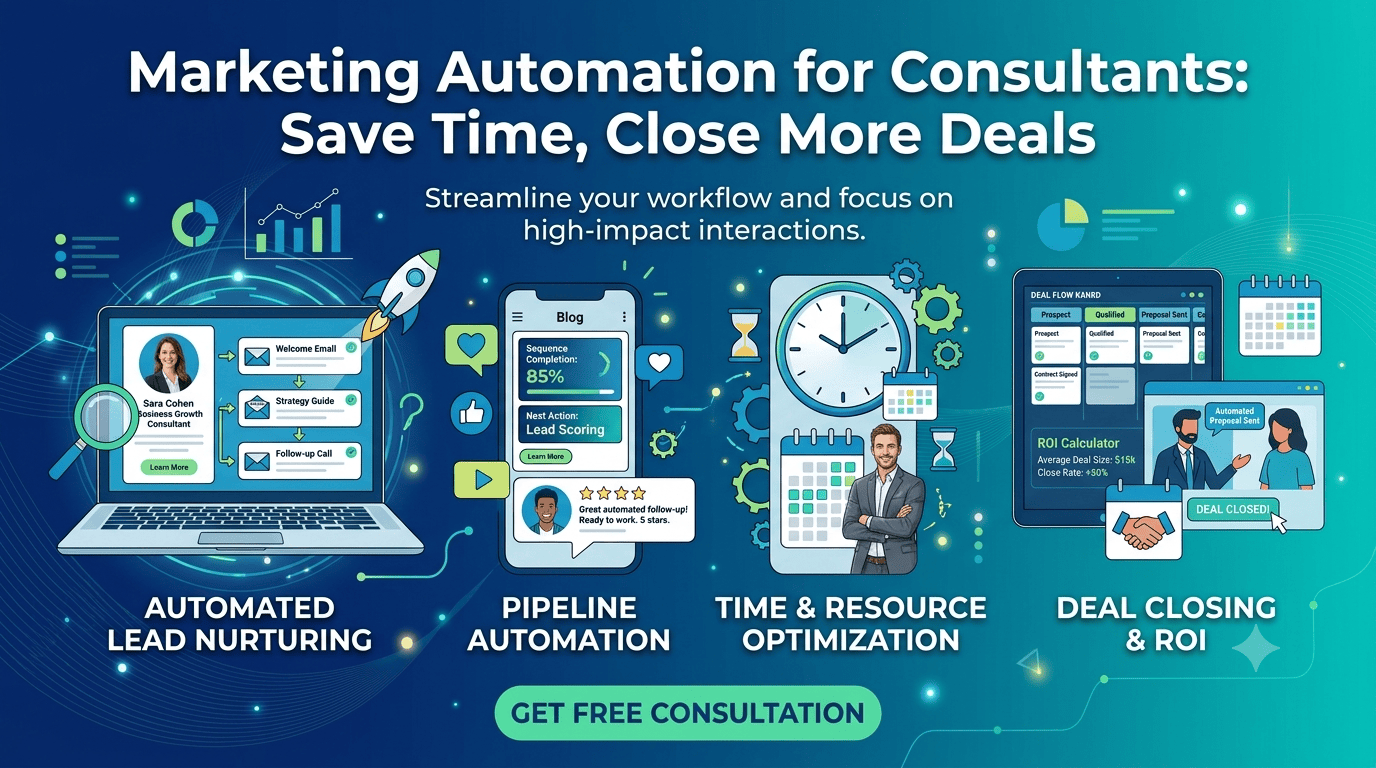
If you’re building — or buying — marketing automation for consultants, these five systems form the backbone of a firm that converts leads without burning out its team.
1. Automated Lead Qualification and Scoring
Not every inquiry deserves the same attention. A scoring system automatically flags budget, timeline, and fit signals from a form submission or discovery-call request, so your team spends time on the leads most likely to close.
- Application or intake forms that capture budget range and urgency upfront
- Automatic tagging of high-intent behavior (pricing page visits, repeat email opens)
- Instant routing of high-score leads to a calendar link, low-score leads into a longer nurture track
2. Multi-Touch Email Nurturing Flows
Most B2B buyers aren’t ready to buy the moment they find you. A structured, multi-touch sequence keeps building trust over weeks or months without anyone manually sending a single email.
This is exactly what TAYA’s automated email marketing and lead nurturing solutions are designed to handle — segmenting leads by behavior and keeping the right message in front of the right prospect at the right time.
Pro-Tip: Build your first nurture sequence around objections, not just value — one email addressing “why now” and another addressing “why you” will usually outperform five generic value-driven emails.
3. Seamless Calendar and Booking Automation
Nothing kills momentum like a five-message back-and-forth just to schedule a call. Direct-booking automation removes that friction entirely, letting a qualified lead choose a time instantly.
- Calendar links embedded directly in the first automated response
- Automatic time-zone detection and reminder sequences to cut no-shows
- Pre-call intake forms that arrive automatically once a slot is booked
Data on this effect is consistent across sources: enabling immediate self-service booking after an inquiry has been shown to roughly double inbound conversion compared to manual scheduling coordination.
4. Onboarding and Client Offboarding Automation
The sales win isn’t the finish line — a clunky onboarding process can undo the trust built during the sales process in the first week of the engagement. Automating contracts, welcome sequences, and intake paperwork protects that momentum.
- Automated contract and payment collection triggered the moment a deal closes
- A structured welcome sequence with clear next steps and expectations
- Automatic scheduling of kickoff calls without manual coordination
5. Integrated CRM and Revenue Tracking
None of the above matters if you can’t see which channel, campaign, or sequence actually produced closed revenue. A properly integrated CRM connects every touchpoint to a dollar figure, not just an activity count.
Salesforce’s ongoing research into buyer expectations reinforces why this matters: real-time responsiveness and visibility into the full customer journey are increasingly treated as table stakes, not a differentiator. See the full findings in the Salesforce State of Marketing Report.
Building an Automated High-Ticket Sales Funnel Architecture
A high-ticket consulting funnel needs more structure than a simple opt-in form. Here’s the step-by-step architecture that consistently performs well for boutique consulting firms:
- Traffic source — content, referrals, or paid ads driving prospects to a single, focused landing page.
- Qualifying application — a short form capturing budget, timeline, and specific problem, feeding directly into TAYA’s automated lead generation systems for consultants.
- Instant acknowledgment — an automated email or text confirming receipt within seconds, not hours.
- Pre-call nurture — a short sequence of trust-building content sent before the discovery call happens.
- Direct booking — a calendar link with automatic reminders to reduce no-shows.
- Post-call follow-up automation — proposal delivery, objection-handling content, and a scheduled check-in if the prospect goes quiet.
Manual Lead Follow-Up vs. Automated Nurturing Ecosystem
| Criteria | Manual Lead Follow-Up | Automated Nurturing Ecosystem |
|---|---|---|
| Response time | Hours to days, inconsistent | Seconds to minutes, every time |
| Scalability | Breaks down as lead volume grows | Scales without added headcount |
| Consistency | Depends on individual memory | Runs the same sequence every time |
| Lead qualification | Manual review of every inquiry | Automatic scoring and routing |
| Visibility into ROI | Fragmented, hard to track | Centralized CRM and revenue attribution |
| Team bandwidth | Constantly reactive | Freed up for delivery and strategy |
Pro-Tip: When choosing a CRM for consulting firms, prioritize one with native automation and calendar-booking integration over one with the most features — a tool your team actually uses consistently beats a powerful tool that sits half-configured.
This funnel logic maps closely to the frameworks explored in TAYA’s broader guides on marketing agency for consultants, digital marketing agency for coaches, and the healthcare marketing agency guide — different industries, same underlying principle: automate the repeatable, protect the human touch for what actually requires it.
Case Study: 15 Hours Saved Weekly, 130% Higher Call Conversion
Consider a composite, illustrative scenario reflecting the pattern TAYA sees repeatedly with boutique B2B consulting firms — a two-partner strategy consultancy relying entirely on manual email follow-up and a shared calendar link.
Starting point: Inbound leads sat unanswered for a day or more during busy delivery weeks, no lead scoring existed, and discovery-call show rates hovered well below industry norms.
What changed over the automation rollout:
- Phase 1: Built an instant-acknowledgment sequence and qualifying intake form, replacing the generic “contact us” page.
- Phase 2: Layered in a multi-touch nurture sequence for leads not immediately ready to book, plus automated reminders to cut no-shows.
- Phase 3: Connected the whole system to a CRM with revenue attribution, so partners could see exactly which content and sequences produced booked, closed clients.
Illustrative result pattern: the partners reported reclaiming approximately 15 hours per week previously spent on manual follow-up, and discovery-call-to-client conversion improved by roughly 130% once instant response and structured nurturing replaced ad-hoc email chasing — consistent with the broader speed-to-lead research cited throughout this guide.
Verified, documented engagements are available in TAYA’s B2B automation case studies.
Conclusion: Turn Marketing From a Time Drain Into a Revenue Engine
Every hour spent manually chasing leads is an hour taken from the work that actually pays your invoices. Marketing automation for consultants isn’t about replacing the human relationship that closes high-ticket deals — it’s about making sure that relationship starts before a competitor gets there first.
Automated lead nurturing, seamless booking, structured onboarding, and a CRM that actually shows you where revenue comes from turn marketing from a daily chore into a system that runs quietly in the background while you deliver client work.
If your firm is still coordinating follow-up over email threads and shared calendars, Book a free strategy audit call with TAYA Agency and get a specific plan for automating the parts of your funnel that are currently costing you deals.
Frequently Asked Questions
What is marketing automation for consultants, and why is it necessary in 2026?
Marketing automation for consultants is a connected system of tools and sequences — instant lead response, nurturing emails, booking, and CRM tracking — that replaces manual, ad-hoc follow-up. It’s necessary because response speed and consistency now directly determine which vendor a B2B buyer chooses.
Will marketing automation make my consulting business feel impersonal to high-ticket clients?
No, when built correctly. Automation handles instant acknowledgment, scheduling, and early nurturing, while the actual discovery calls and strategic conversations stay fully human. The goal is removing friction and delay, not removing the relationship that closes high-ticket deals.
What are the best marketing automation tools for boutique consulting firms?
The right tool depends on team size and existing workflow, but boutique firms generally do best with a CRM offering native email automation, calendar-booking integration, and lead scoring in one connected system, rather than several disconnected point tools that require manual data transfer.
How long does it take to build and launch an automated sales funnel for consultants?
A functional core system — instant response, a basic nurture sequence, and direct booking — can typically launch within two to four weeks. A fully integrated funnel with CRM revenue tracking and onboarding automation usually takes 60 to 90 days to build and refine properly.
How can TAYA Agency help set up a complete marketing automation system for my business?
TAYA Agency builds the full stack for consulting firms — lead generation and qualification, automated email nurturing, booking automation, and CRM integration with revenue attribution — so every inbound inquiry is followed up instantly and tracked through to closed revenue.